
Special Offer on New Rentals: First 3 Months at Special Pricing + Free Lock | Reserve Online Today!

If you are standing in the middle of your house right now trying to decide what stays, what goes to the new place, and what disappears into a box you might not open for some time, a downsizing home checklist is exactly what you need before you make a single decision you will regret later. Downsizing does not mean giving up on objects that are important to you.
There is an option most families never plan for on purpose: keeping the things that still matter, just not all in the same house. That is what a good checklist helps you do.
Whether you are moving to a smaller home, merging two households into one, clearing out a nursery that just became a home office, or finally tackling the garage nobody has parked a car in for years, the same question keeps coming up. What do you keep at home, what do you use seasonally, and what makes more sense to store for now?
Most downsizing tips online tell you to “just declutter,” which is a little like telling someone to “just relax.” True, but not exactly actionable. A real downsizing home checklist gives you an actual system instead of a vague suggestion.
Downsizing rarely feels like one clean decision. It feels like a hundred small decisions stacked on top of each other, each one carrying its own little pocket of guilt, nostalgia, or plain exhaustion. That overwhelmed feeling is not a sign you are bad at this. It is a sign you are trying to sort a lifetime of belongings without a system.
A system changes everything. Once you have a downsizing home checklist that tells you exactly what to look at room by room, the process stops being an emotional minefield and starts being a series of manageable, five-minute decisions. Instead of standing in the middle of a room overwhelmed by everything at once, you are just answering one question about one item at a time.
This matters more during decluttering , because as time passes, you feel more pressure, makingevery decision feel more energy draining . A checklist takes the pressure off by giving you permission to sort things into “store for now” instead of forcing an immediate keep-or-toss verdict on everything you own.
It also helps to remember that downsizing is not a single event with a single deadline. Even if a moving truck is scheduled, the actual sorting can happen in stages over weeks, one room at a time, rather than all at once the weekend before. Treating it as a series of smaller decisions rather than one enormous project is often the difference between finishing calmly and finishing exhausted.
Start small and start with the lowest-emotion spaces first. Garages, linen closets, and junk drawers are easier to sort through than a childhood bedroom or a late parent’s belongings, so tackling those first builds momentum before you reach anything sentimental. Give yourself a real timeline, not a single overwhelming weekend, and sort everything into four piles: keep at home, store for now, donate or sell, and toss.
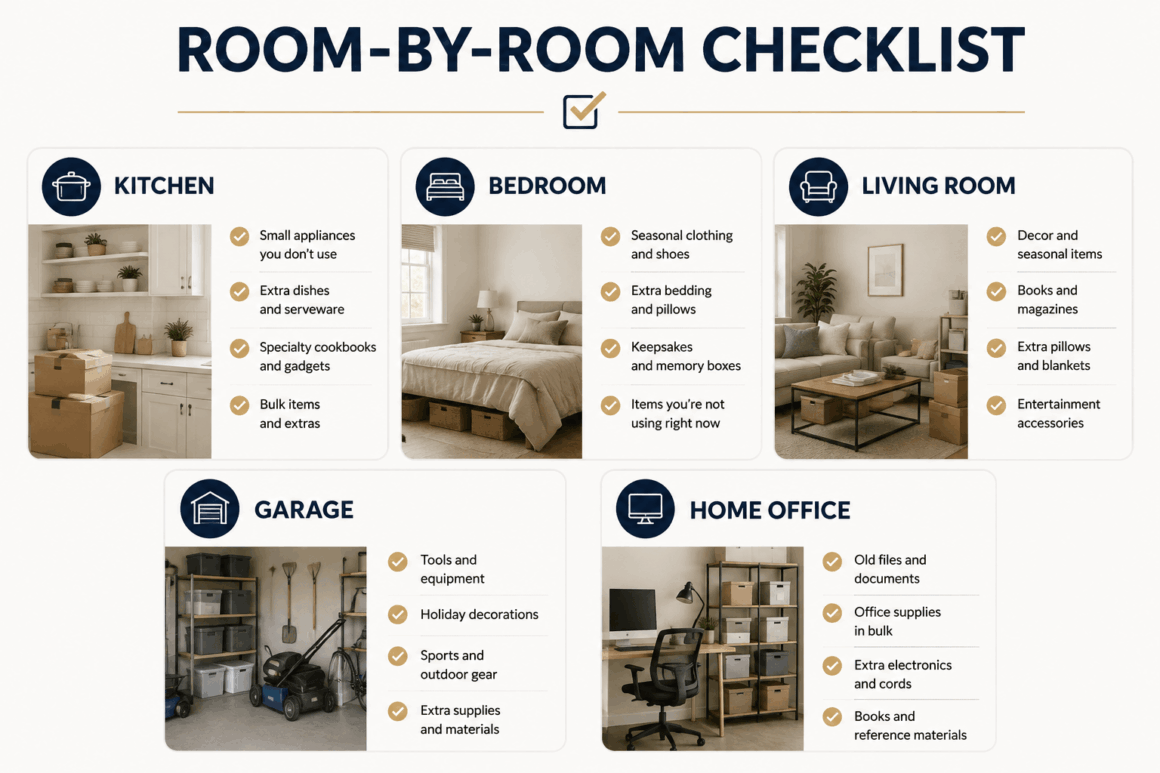
This is the heart of any real downsizing home checklist. Instead of trying to make one big decision about your entire house, walk through it room by room and ask the same three questions in each one: do I use this regularly, do I have room for it in the new space, and would I regret storing it for a year.
Kitchen. Keep the appliances and cookware you trully use to cook and eat. Store the holiday dishware, the extra serving platters, and the appliances you use twice a year, like a turkey roaster or an ice cream maker. Duplicate items, especially a second full set of dishes from a merged household, are strong storage candidates rather than keep-at-home items. If you are combining two kitchens into one, expect to find at least one full duplicate set of everyday dishes, and consider storing the nicer of the two rather than deciding to sell it on the spot.
Two people moving in together are also merging two histories, and not every duplicate is only a duplicate. Some of it is the set someone’s mother gave them. Storage lets you keep the peace and the pieces while you sort it out.
Bedrooms. Keep your everyday wardrobe and the furniture your new space can fit. Store out-of-season clothing, formalwear you wear once a year, and furniture from a bedroom that will not exist in your next home, like a second guest bed you are not ready to sell yet.
Living and dining rooms. Keep the furniture that fits your new floor plan and the pieces you use daily. Store the dining set that only comes out for holidays if your new place has a smaller table, along with any furniture you are holding onto for a family member who is not ready to take it yet.
This is often where the most emotionally difficult decisions live too, a parent’s dining table or a couch from your first apartment, and storage gives you a way to hold onto it without it dictating the layout of your new home.
Garage and storage areas. This is usually where the most storage-worthy items live. Keep the tools and equipment you use several times a month. Store seasonal equipment, holiday decorations, sports gear that only comes out part of the year, and anything you are keeping “just in case” but have not touched in over a year.
Hallways and closets. These are the spaces that quietly fill up over years without anyone noticing until moving day forces a real look. Keep the coats, shoes, and linens you use regularly. Store extra bedding sets, out-of-season coats, and the box of cords and chargers for electronics you no longer own but have not gotten around to tossing.
Home office. Keep your active files and the equipment you use weekly. Store old tax documents you are required to keep but rarely need, retired electronics, and furniture from an office that is shrinking to a corner desk in the new place. If your new home does not leave room for a real workspace at all, a flexible option like Cornerstone Office Spaces can give you a place to work without needing to fit a full office into a smaller house.
What should I keep versus store when downsizing?
Keep anything you use at least once a month and anything that will not fit in your new space’s storage plan. Store items you use only seasonally, duplicates from merging households, furniture you are not ready to part with but do not currently need, and sentimental items you want to hold onto without them taking up daily living space. If you have not touched something in over a year and it is not seasonal or sentimental, it is usually a donate or toss candidate rather than a storage one.
Sentimental items deserve their own bit of patience. Nobody makes a good decision about a parent’s china cabinet or a childhood keepsake box in the middle of a rushed move. If something falls into that category and you genuinely cannot decide yet, storing it is a perfectly reasonable answer. Giving yourself six months of distance from a decision almost always makes it easier to make well, rather than forcing a verdict while everything else in the house is also in boxes.
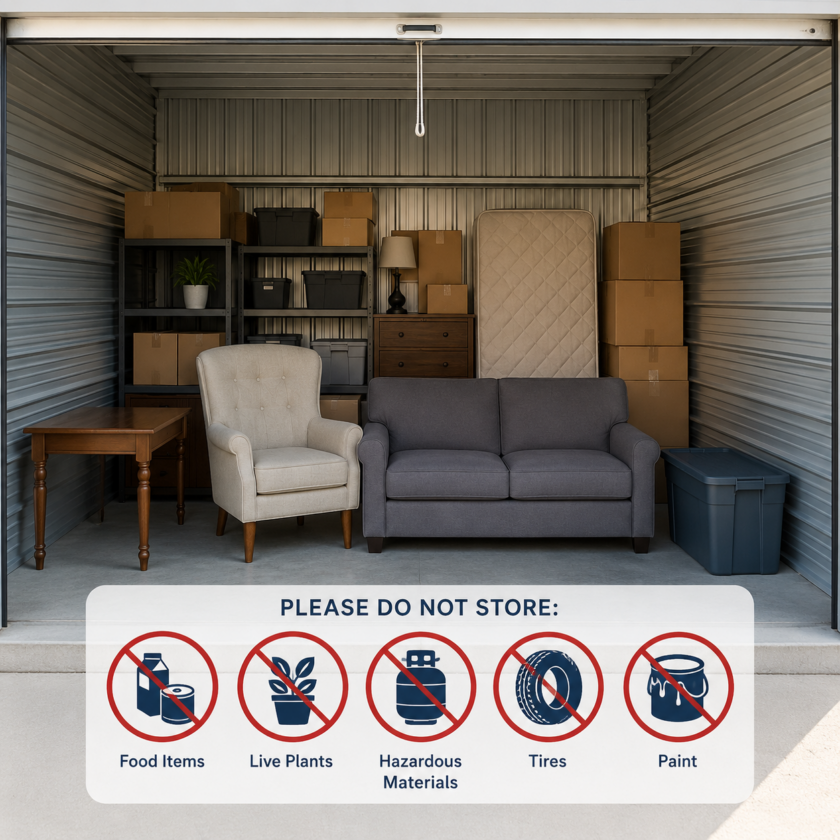
Once you know what you are storing, it is just as important to know what not to store in a storage unit in the first place. Every reputable facility has rules here, and they exist for real safety reasons, not just fine print.
Food of any kind is off-limits, since it attracts pests that can damage everyone’s belongings in the facility, not just yours. Live plants will not survive without sunlight and water, so give them to a neighbor or family member instead. Pets and animals can never be left in a storage unit under any circumstances. Hazardous materials, including fuel, propane, paint thinners, chemicals, and fireworks, are prohibited because they pose a real fire and health risk. Wet or damp items should never go into storage since moisture creates the exact conditions mold needs to grow, damaging your belongings and everyone else’s.
High-value items like jewelry, cash, or irreplaceable heirlooms are worth a second thought too. Most facilities will store them, but a personal safe at home or a small safety deposit box is often the smarter call for anything you truly could not replace.
What items are not allowed in a storage unit?
Storage facilities prohibit food, live plants, animals, hazardous or flammable materials such as fuel and chemicals, and anything wet or damp that could develop mold. Most facilities also strongly discourage storing irreplaceable high-value items like jewelry or cash, since no facility can fully replace something with pure sentimental worth. If you are unsure whether something qualifies, ask your storage advisor before move-in day rather than after
With locations in Bondurant and Council Bluffs, Iowa; Omaha, Bellevue, Wahoo, and Yutan, Nebraska; and Sioux Falls, South Dakota, there's a Cornerstone Storage close enough to make this easy.
Use the size calculator
This is the question every downsizing family or couple eventually asks themselves, usually while standing in a garage full of boxes wondering if they are just delaying the real decision.
A storage unit does not give you more time to move. The truck still comes. What it gives you is a way to hit that deadline without deciding the fate of everything you own in one weekend. The uncertain things go to the unit instead of the curb, and the real decisions happen later, from your new home. That is what helps a family adjusting to a new house, a couple deciding whose things stay, or someone moving alone who should not have to purge a life on the hardest week to do it.
It also gives your belongings a place to matter without being underfoot. The holiday decorations, the summer gear, the crib you are keeping for someday all have somewhere to wait until their season comes back around, instead of crowding the closets year round. And it gives you room to actually live in the new place while you figure it out. Space to move furniture around, to see how a room wants to be used, to try the home office one way and then another before anything is permanent. The things tied to a person or a chapter stay safe and close by, and the house stays yours to plan and play with, one calm decision at a time.
Downsizing under pressure leads to bad decisions. People sell things they wish they had kept and keep things they wish they had let go, all because they had to decide everything in one weekend before the moving truck showed up. A storage unit removes that pressure. It gives you a safe, secure place to put the “not sure yet” pile so you can make that decision in a month, not in the fifteen minutes before the truck leaves.
For families searching self storage units Omaha has to offer, the value is not just the extra square footage. It is the breathing room to downsize thoughtfully instead of frantically, without a single item going to the curb just because there was nowhere else for it to go in the moment.
A good downsizing home checklist paired with the right size storage unit turns a stressful, rushed process into one you control.
If you are also trying to figure out what size unit fits everything on your keep-for-storage list, our guide on choosing the right unit size before you rent walks through exactly that.
Is it worth renting a storage unit when downsizing?
Yes, particularly during the transition itself. A storage unit lets you separate the urgent decisions, what fits in the new home right now, from the ones that can wait, like sentimental items or furniture you are not ready to sell. That separation alone prevents most of the regretted decisions people make when downsizing under time pressure.
You do not need a firm moving date to start this process, and honestly, starting before you need to is the whole point. A few signs it is time to begin your downsizing home checklist:
None of these mean something has gone wrong. They just mean it is time to sort the keep pile from the store pile, on your own timeline, before anyone is standing over you with a truck outside.
Downsizing is not about giving things up. It is about deciding, room by room and on your own terms, what actually belongs in your daily life right now and what deserves a safe place to wait until you need it again.
It’s ok to need space for yourself.

Tell a friend about Cornerstone Storage.